

Have you ever wondered what drives the transition of sea lamprey from harmless filter-feeding larvae to one of the Great Lakes’ most effective parasites? A fully funded MS graduate assistantship sea lamprey Michigan State University opportunity now offers the chance to answer that question through hands-on research on juvenile feeding behavior and early parasitic growth.
Michigan State University’s That Lamprey Lab, led by Dr. John B. Hume in the Department of Fisheries and Wildlife, is recruiting a master’s student to join the Sea Lamprey Aquaculture and Procurement (SLAP) Initiative. This Great Lakes Fishery Commission-supported program develops reliable methods for producing and maintaining later life stages of sea lamprey for research and management. The position starts in Spring 2027 (after January 1, 2027) and combines laboratory work in East Lansing with periodic research at the historic Hammond Bay Biological Station on Lake Huron.
Scholarship Summary
- Host Country: USA
- Host University: Michigan State University
- Scholarship Type: MSC Scholarships
- Eligible Countries: All Countries
- Scholarship Benefits: Full tuition fee, Living stipend, etc.
Why Sea Lamprey Research Matters in the Great Lakes
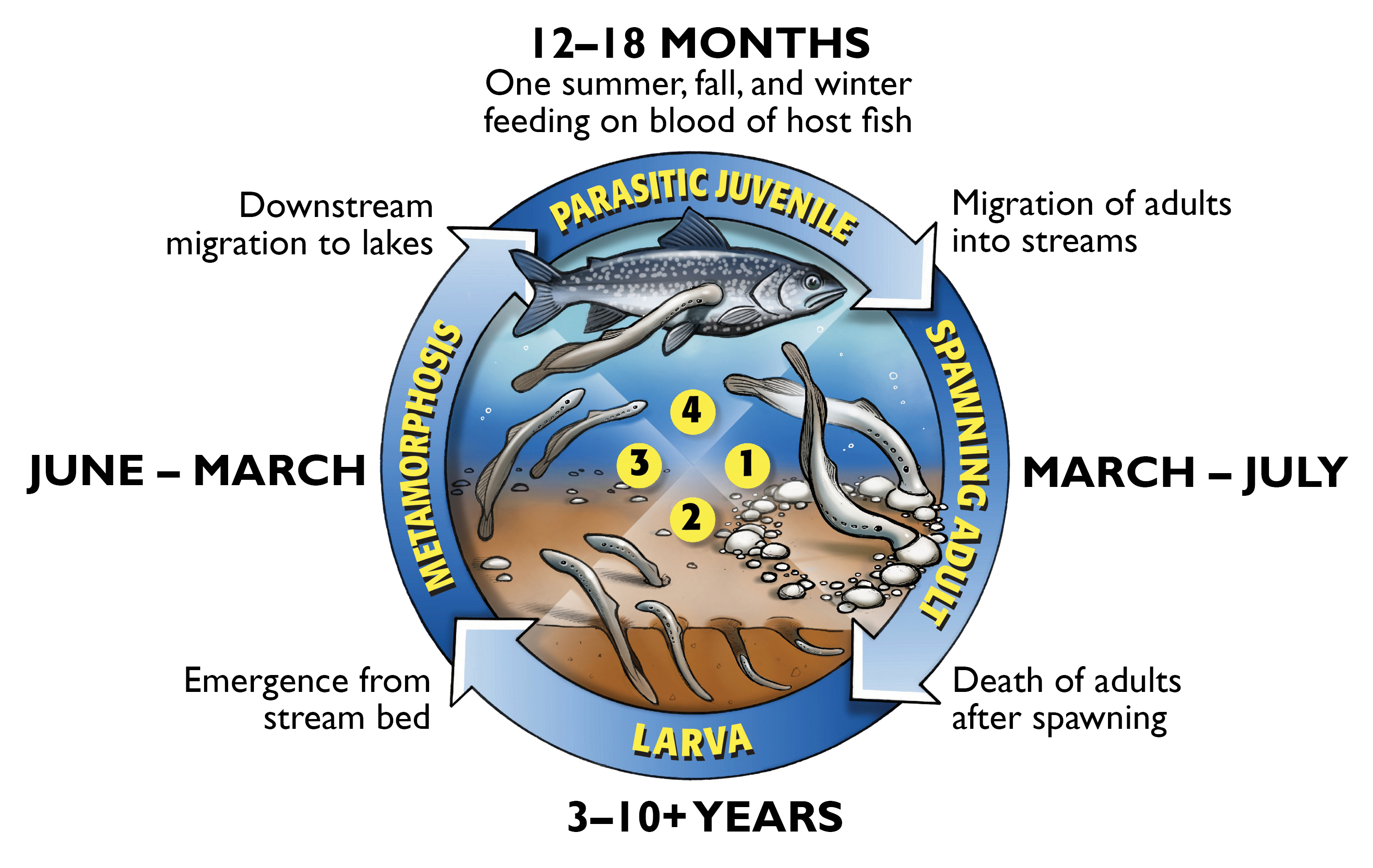
Sea lampreys entered the upper Great Lakes around 1921 and quickly became a devastating invasive species. Without natural predators or co-evolved defenses in native fish populations, each parasitic juvenile sea lamprey can kill up to 40 pounds of fish during its 12–18 month feeding period. Before effective control programs, sea lampreys destroyed commercial and recreational fisheries, reducing lake trout catches in the upper Great Lakes from roughly 15 million pounds annually to just 300,000 pounds by the early 1960s.
Today, coordinated efforts by the Great Lakes Fishery Commission and partners have reduced sea lamprey populations by about 90% in most areas through lampricides, barriers, and traps. The result is a rehabilitated fishery ecosystem supporting billions in economic value. Yet challenges remain: rising costs, potential lampricide resistance, and the need for more selective control tools. This is where advanced research on juvenile behavior, host-parasite interactions, and captive rearing becomes essential.

The SLAP Initiative addresses a practical bottleneck: producing consistent, high-quality juvenile sea lamprey in captivity for experiments instead of relying solely on wild collections. Your work as the graduate research assistant will directly support this goal while generating fundamental insights into the biology of parasitism.
See More Posts in Jobs, Scholarships, Technology, Career/Motivations, Football News Feeds
Join Job Whatsapp Channel, Scholarship Whatsapp Channel, Tech Whatsapp Channel, Follow Our Twitter (X) Channel.
What the Research Project Involves
You will lead a comparative study examining laboratory-reared versus wild-origin juvenile sea lamprey. Key questions include:
- Do the two groups differ in host-seeking behavior?
- How do attachment success, feeding duration, wound characteristics, survival, and growth compare when offered live host fishes under controlled laboratory conditions?
- What does this reveal about the transition to parasitism and the suitability of captive-reared juveniles for broader research and management applications?
Depending on juvenile availability and project progress, you may also contribute to evaluating artificial feeding approaches, including feeder design, host-associated sensory cues, and short-term attachment or feeding responses.
The work blends behavioral ecology, aquaculture, and applied fisheries management. You will gain direct experience in aquatic animal husbandry, designing and running behavioral experiments, handling juvenile sea lamprey, observing host–parasite interactions (via video or direct methods), experimental design, data management, and statistical analysis. Research activities will involve travel to Hammond Bay Biological Station, a premier USGS facility with decades of sea lamprey and native fish research history.
See Also:
- Aarhus University Scholarships for International Students in Europe: Your 2026 Guide to Danish State Full Funding Without Extra Applications

- Unlock Your Future in AI: The Complete Guide to the SECAI Scholarship in Germany
- Apply for the Prestigious Nestlé Scholarship for Women at IMD MBA 2026


Qualifications and Who Should Apply
Required qualifications include a bachelor’s degree in fisheries, biology, ecology, natural resources, animal science, physiology, or a related field by the start date, plus at least two years of relevant experience. You should demonstrate strong organizational skills, attention to detail, the ability to work independently and collaboratively, excellent written and oral communication, and genuine willingness to work with live animals.
Preferred qualifications include hands-on experience with fish husbandry or aquatic laboratory systems, behavioral experiments or video-based observation, fisheries field or laboratory research, statistical analysis or data management, and familiarity with Great Lakes ecosystems, sea lamprey biology, host–parasite interactions, or applied fisheries management.
Ideal candidates are curious, detail-oriented researchers who want to contribute to both basic science and real-world invasive species solutions. Whether your background is in aquaculture, animal behavior, ecology, or fisheries management, this position offers a clear pathway to deepen expertise while producing publishable research.
Funding, Benefits, and Location
The assistantship provides an annual graduate stipend starting at $32,000, tuition support, and health benefits. Final stipend levels follow Michigan State University and Department of Fisheries and Wildlife rates. Support is contingent on final project funding, satisfactory academic progress, and admission to MSU’s graduate program.
You will be based primarily in East Lansing for coursework and some lab work, with research periods at Hammond Bay Biological Station near Millersburg, Michigan. The combination offers the resources of a major research university alongside immersive field-station experience on the shores of Lake Huron.
Click Here to See other Scholarships.
Get Standard CV and Scholarship Essay/Statement of Purpose/Motivation Letter from a Professional.
- Join this Whatsapp Channel to Get More Infos and Tips
- Join Telegram Channel for Daily Jobs, Scholarships, Business and Career Updates
How to Apply for This MS Graduate Assistantship
Review of applications begins September 15, 2026, and continues until the position is filled. Early applications are strongly encouraged.
Send the following materials to Dr. John B. Hume at jhume@msu.edu:
- Cover letter describing your research interests, relevant experience, and career goals.
- Current CV or résumé.
- Unofficial transcripts.
- Contact information for 2–3 professional or academic references.
- A brief statement explaining why this specific project interests you.
Full position details are available at the official posting: https://jobs.rwfm.tamu.edu/view-job/?id=116797
Learn more about the lab and its research at https://thatlampreylab.com. Additional context on sea lamprey biology and control is available from the Great Lakes Fishery Commission at https://www.glfc.org/sea-lamprey.php and Hammond Bay Biological Station information at the USGS Great Lakes Science Center.
Why This Opportunity Stands Out
This is more than a typical graduate assistantship. You will work at the intersection of fundamental biology and applied management on a high-profile invasive species that has shaped the entire Great Lakes ecosystem for a century. The SLAP Initiative represents a forward-looking shift toward sustainable, lab-based production of research animals, reducing pressure on wild populations while accelerating discovery.
Graduates from similar positions in the That Lamprey Lab and MSU’s Fisheries and Wildlife program move into roles with federal and state agencies (USGS, USFWS, state DNRs), the Great Lakes Fishery Commission, universities, and consulting or conservation organizations. The skills you develop—experimental design, behavioral analysis, aquaculture techniques, statistical rigor, and science communication—are highly transferable across aquatic ecology, invasive species management, and aquaculture fields.
Take the Next Step in Your Fisheries or Aquatic Ecology Career
If you are passionate about understanding host–parasite systems, improving invasive species management, or advancing aquaculture methods for research animals, this MS graduate assistantship sea lamprey Michigan State University position offers an outstanding platform. Applications are now open for a Spring 2027 start.
Prepare your materials and reach out to Dr. John Hume soon. Strong candidates who apply before the September 15, 2026 review date will have the best chance of securing this competitive opportunity.
For more graduate assistantships, fisheries research positions, and fully funded opportunities in aquatic sciences, explore additional resources on techschoolinfo.com and stay connected with scholarship and career alerts through established channels.
This position has the potential to launch a meaningful career while contributing to the long-term health of the Great Lakes fishery. Start preparing your application today.